Peng et al: Comparison of remote and in-person respiratory function grading of brachycephalic dogs
Veterinary Surgery 3, 2025

🔍 Key Findings

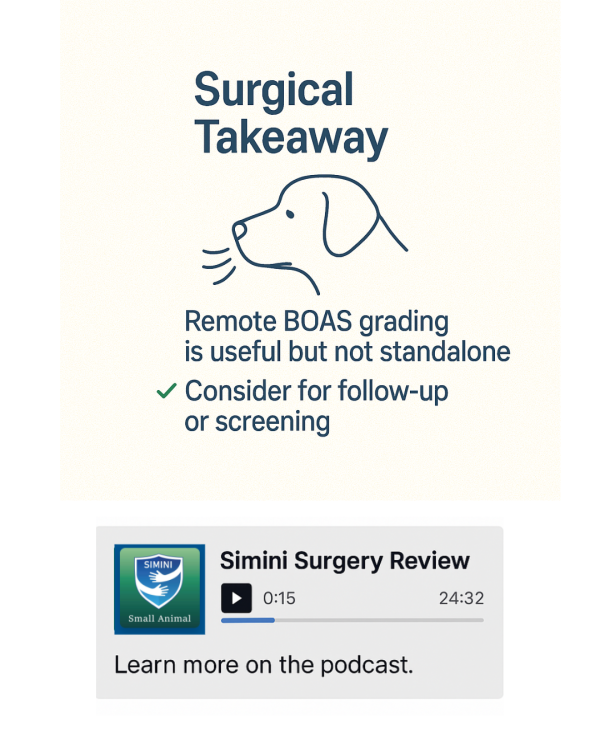
  • Remote respiratory function grading (RFG) had poor to moderate reliability compared to in-person assessment.
  • Expert graders had higher agreement with in-person scores than novices (Cohen’s kappa 0.37–0.48 vs. 0.21–0.47).
  • Interobserver agreement was moderate among experts (Fleiss’ kappa = 0.59) and poor among novices (Fleiss’ kappa = 0.39).
  • Remote recordings suffered from background noise, short clip durations, and technical limitations of electronic stethoscope recordings.
  • Final RFG scores were based on the highest grade across categories (respiratory noise, inspiratory effort, dyspnea/cyanosis/syncope).
  • Clinical impact: Only in-person grading reliably supports decisions for surgical intervention or breeding restrictions.
Comparison of remote and in-person respiratory function grading of brachycephalic dogs

Simini Surgery Review Podcast

How critical is this paper for crushing the Boards?

🚹 Must-know. I’d bet on seeing this.

📚 Useful background, not must-know.

đŸ’€ Skip it. Doubt it’ll ever show up.

Thanks for the feedback!
‍
We'll keep fine-tuning the articles vault.
Oops — didn’t go through.
‍
Mind trying that again?

Peng et al: Comparison of remote and in-person respiratory function grading of brachycephalic dogs
Veterinary Surgery 3, 2025

🔍 Key Findings

  • Remote respiratory function grading (RFG) had poor to moderate reliability compared to in-person assessment.
  • Expert graders had higher agreement with in-person scores than novices (Cohen’s kappa 0.37–0.48 vs. 0.21–0.47).
  • Interobserver agreement was moderate among experts (Fleiss’ kappa = 0.59) and poor among novices (Fleiss’ kappa = 0.39).
  • Remote recordings suffered from background noise, short clip durations, and technical limitations of electronic stethoscope recordings.
  • Final RFG scores were based on the highest grade across categories (respiratory noise, inspiratory effort, dyspnea/cyanosis/syncope).
  • Clinical impact: Only in-person grading reliably supports decisions for surgical intervention or breeding restrictions.

Simini Surgery Review Podcast

Join Now to Access Key Summaries to more Veterinary Surgery Articles!

Multiple Choice Questions on this study

In Peng 2025 et al., on grading reliability, 
 what was the main limitation of remote grading identified?

A. Short exercise duration
B. Low breed diversity
C. Small sample size
D. Background noise and poor recording quality
E. Untrained owners

Answer: Background noise and poor recording quality

Explanation: Background distractions and poor audio quality compromised grading accuracy.
In Peng 2025 et al., on novice evaluator performance, 
 which grader had the highest agreement with the gold standard?

A. Novice A
B. Novice B
C. Novice C
D. Novice D
E. None of the novices

Answer: Novice B

Explanation: Novice B achieved the highest Cohen's kappa (0.47) among novice graders.
In Peng 2025 et al., on BOAS clinical grading, 
 what characterizes a Grade 2 RFG score?

A. No audible noise, no dyspnea
B. Mild noise only via stethoscope
C. Moderate noise audible without stethoscope and post-exercise dyspnea
D. Severe noise with cyanosis
E. Mild inspiratory effort only

Answer: Moderate noise audible without stethoscope and post-exercise dyspnea

Explanation: Grade 2 indicates clinical signs with noise audible without a stethoscope and some post-exercise signs.
In Peng 2025 et al., on study design, 
 how were the final RFG scores determined for each dog?

A. Average of expert scores
B. Median of pre- and post-exercise grades
C. Consensus among all evaluators
D. Highest grade observed in any category or stage
E. Only post-exercise score was used

Answer: Highest grade observed in any category or stage

Explanation: This approach captures the most severe respiratory dysfunction encountered during evaluation.
In Peng 2025 et al., on grading reliability, 
 what was the overall interobserver reliability among expert remote graders?

A. Fleiss’ kappa = 0.39
B. Fleiss’ kappa = 0.47
C. Fleiss’ kappa = 0.59
D. Fleiss’ kappa = 0.28
E. Fleiss’ kappa = 0.68

Answer: Fleiss’ kappa = 0.59

Explanation: This value reflects moderate agreement among expert graders using remote recordings.


Elevate Your Infection Control Protocol

Implement Simini Protect Lavage for superior, clinically-proven post-operative skin antisepsis and reduced infection risk.