Carvajal et al: Breakage of cementless press‐fit femoral stems following total hip arthroplasty in dogs: 14 cases (2013–2023)
Veterinary Surgery 3, 2025

🔍 Key Findings

Incidence of BFX lateral bolt stem breakage: 2.95% (13 dogs, 14 stems)

Implant factors:

  • 13/14 were BFX lateral bolt stems (sizes #5–7)
  • +9 necks used in 5/11 of 17 mm heads
  • 10/14 stems undersized based on radiographs
  • 10/13 dogs exceeded weight limits for implanted stem size

Malalignment:

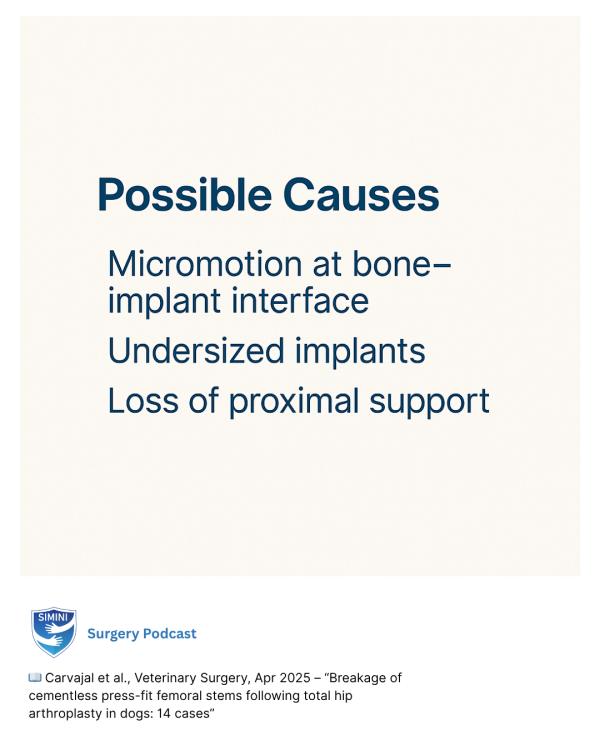
  • 10/14 had varus alignment (median 3.9°)
  • 8/14 had insufficient proximodistal seating

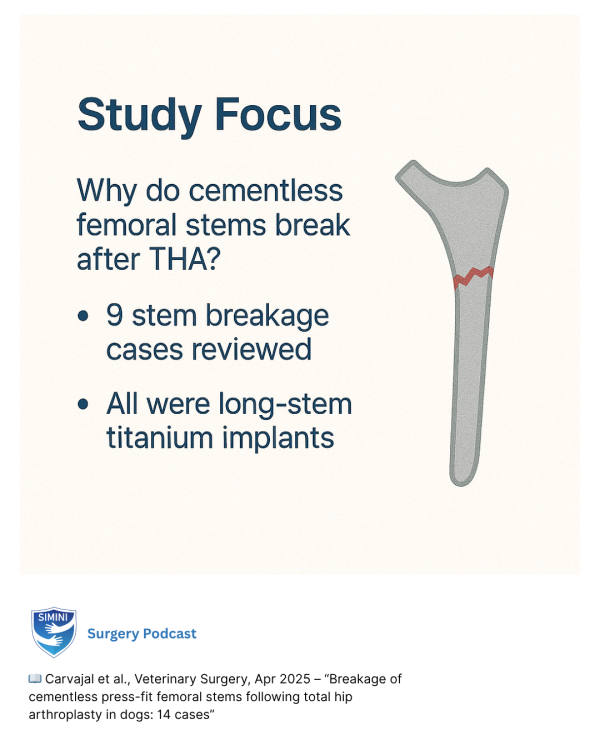
Breakage site: Proximolateral shoulder in all cases

Revision outcomes:

  • 11 revised (7 CFX, 3 larger BFX, 1 collared)
  • 9/10 revised dogs regained full function
  • Complications: 1 rebreakage, 1 periprosthetic fracture, 1 fixation failure

Histopathology:

  • Electron microscopy showed fatigue striations and incomplete bead fusion

Conclusion: Avoid small BFX lateral bolt stems if undersized or if long necks required; use weight guidelines to prevent fatigue failure.
Breakage of cementless press‐fit femoral stems following total hip arthroplasty in dogs: 14 cases (2013–2023)

Simini Surgery Review Podcast

How critical is this paper for crushing the Boards?

🚹 Must-know. I’d bet on seeing this.

📚 Useful background, not must-know.

đŸ’€ Skip it. Doubt it’ll ever show up.

Thanks for the feedback!
‍
We'll keep fine-tuning the articles vault.
Oops — didn’t go through.
‍
Mind trying that again?

Carvajal et al: Breakage of cementless press‐fit femoral stems following total hip arthroplasty in dogs: 14 cases (2013–2023)
Veterinary Surgery 3, 2025

🔍 Key Findings

Incidence of BFX lateral bolt stem breakage: 2.95% (13 dogs, 14 stems)

Implant factors:

  • 13/14 were BFX lateral bolt stems (sizes #5–7)
  • +9 necks used in 5/11 of 17 mm heads
  • 10/14 stems undersized based on radiographs
  • 10/13 dogs exceeded weight limits for implanted stem size

Malalignment:

  • 10/14 had varus alignment (median 3.9°)
  • 8/14 had insufficient proximodistal seating

Breakage site: Proximolateral shoulder in all cases

Revision outcomes:

  • 11 revised (7 CFX, 3 larger BFX, 1 collared)
  • 9/10 revised dogs regained full function
  • Complications: 1 rebreakage, 1 periprosthetic fracture, 1 fixation failure

Histopathology:

  • Electron microscopy showed fatigue striations and incomplete bead fusion

Conclusion: Avoid small BFX lateral bolt stems if undersized or if long necks required; use weight guidelines to prevent fatigue failure.

Simini Surgery Review Podcast

Join Now to Access Key Summaries to more Veterinary Surgery Articles!

Multiple Choice Questions on this study

In Carvajal 2025 et al., on femoral stem breakage, which patient factor was frequently present in failed cases?

A. Dog weight below implant guidelines
B. Early postoperative luxation
C. Severe proximal femoral remodeling
D. Dogs exceeding weight guidelines for stem size
E. Bilateral THA within 2 weeks

Answer: Dogs exceeding weight guidelines for stem size

Explanation: 10 of 13 dogs were heavier than manufacturer guidelines for the implanted stem size.
In Carvajal 2025 et al., on femoral stem breakage, what implant feature was shared by the majority of failed stems?

A. Cemented CFX stem
B. Use of +12 neck
C. Use of modular collared stem
D. Use of BFX lateral bolt stem
E. Presence of screw-hole plug

Answer: Use of BFX lateral bolt stem

Explanation: 13 of 14 failed implants were BFX lateral bolt stems, highlighting a common feature among breakages.
In Carvajal 2025 et al., on femoral stem breakage, what was the most common radiographic finding among failed implants?

A. Coxa valga alignment
B. Excessive anteversion
C. Neutral alignment with excellent fill
D. Varus alignment of femoral stem
E. Distal cortical lysis

Answer: Varus alignment of femoral stem

Explanation: Varus malalignment was present in 10 of 14 failed cases, with a median angle of 3.9°.
In Carvajal 2025 et al., on femoral stem breakage, what was the overall success of revision surgery in affected dogs?

A. 3 of 14 regained full function
B. 5 of 11 returned to partial function only
C. 7 of 11 required further surgery
D. 9 of 10 regained full function
E. All 13 were euthanized

Answer: 9 of 10 regained full function

Explanation: Revision outcomes were good: 9 of 10 dogs with follow-up after revision had full functional recovery.
In Carvajal 2025 et al., on femoral stem breakage, what was the most common site of stem failure?

A. Distal tip of the stem
B. Neck-trunnion junction
C. Proximolateral shoulder
D. Midshaft stem junction
E. Bolt-screw interface

Answer: Proximolateral shoulder

Explanation: All failures occurred at the proximolateral shoulder, consistent with high stress concentration and fatigue location.

Elevate Your Infection Control Protocol

Implement Simini Protect Lavage for superior, clinically-proven post-operative skin antisepsis and reduced infection risk.