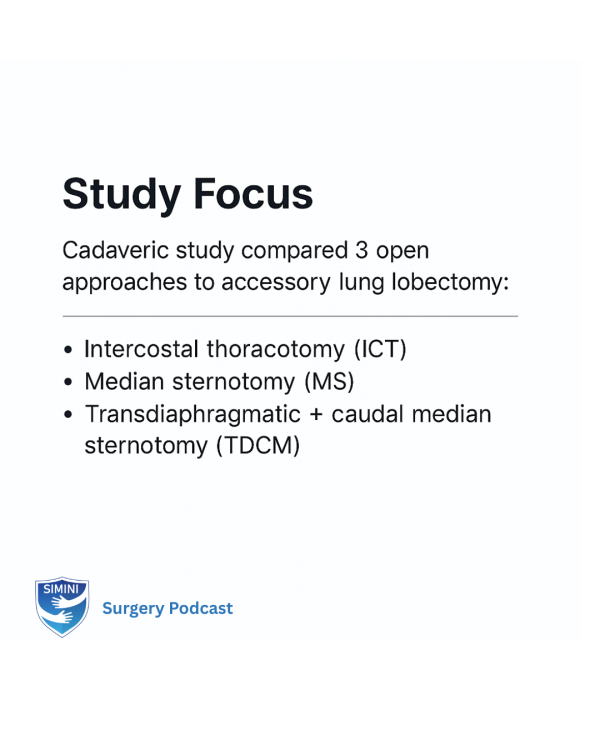
In Duvieusart 2025 et al., on lung lobectomy approaches, which technique provided the greatest surgical exposure?
A. Intercostal thoracotomy (ICT)
B. Median sternotomy (MS)
C. Transdiaphragmatic with caudal sternotomy (TDCM)
D. Thoracoscopic port-assisted
E. Craniocaudal muscle-sparing thoracotomy
Answer: Transdiaphragmatic with caudal sternotomy (TDCM)
Explanation: TDCM had the largest median exposure area (193.5 cm²), significantly more than ICT and MS.
In Duvieusart 2025 et al., on lung lobectomy approaches, what was a key advantage of the TDCM technique?
A. Less postoperative pain
B. Avoidance of chest tubes
C. Shorter surgical time
D. Superior exposure for stapling
E. Reduced hemorrhage risk
Answer: Superior exposure for stapling
Explanation: TDCM approach enabled better access and visibility of the accessory lung lobe.
In Duvieusart 2025 et al., on lung lobectomy approaches, which approach was associated with staple line leaks?
A. TDCM only
B. MS only
C. ICT only
D. MS and ICT
E. All three approaches
Answer: ICT only
Explanation: Staple line leaks occurred in 2 of 4 ICT cases; none were reported in MS or TDCM.
In Duvieusart 2025 et al., on lung lobectomy approaches, what conclusion was drawn about stapler success across techniques?
A. Significantly better in TDCM
B. More reliable in MS
C. Similar across all groups
D. Worse in ICT
E. Unsuccessful in 50% of cases
Answer: Similar across all groups
Explanation: Staplers successfully completed lobectomies in all cases; no group differences noted in success.
In Duvieusart 2025 et al., on lung lobectomy approaches, what percentage of the lung was typically removed by weight across all techniques?
A. 20%–25%
B. 30%–35%
C. 35%–45%
D. 50%–60%
E. 70%–75%
Answer: 30%–35%
Explanation: There was no significant difference in lobectomy weight percentage; the mean was around 32%.