Santos et al: Computed Tomographic Measurement Method for Morphoanatomical Comparison of Femur, Tibia, and Patella in Cats with and without Medial Patellar Luxation
Veterinary and Comparative Orthopedics and Traumatology 1, 2025

🔍 Key Findings

Sample: 21 cats (10 control, 11 affected); 14 normal limbs vs 18 with MPL (MPL II: 7, MPL III: 11).

Significantly different CT measurements in MPL vs control:

  • aLDFA: MPL II > control and MPL III (p = 0.014)
  • FTW: MPL III > control (p = 0.021)
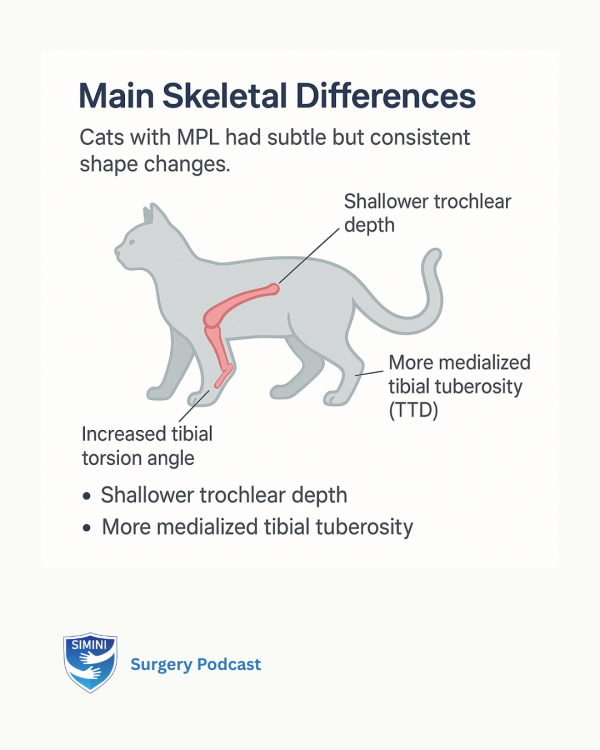
  • FTD: control > MPL II and III (p < 0.001)
  • TTA: MPL II and III had increased external tibial torsion vs control (p < 0.001)
  • fPL and PV: MPL III cats had longer and more voluminous patellae

No significant differences in AA, mMPTA, TTD, fPW, aPH.
Patella width exceeded trochlear width in all groups.
Authors suggest femoral and tibial angular correction may not be indicated in most feline MPL II–III cases.
Soft tissue techniques and trochleoplasty warrant further investigation.
CT method: Intraobserver ICC good in 64%, interobserver poor in 36% of metrics.

Computed Tomographic Measurement Method for Morphoanatomical Comparison of Femur, Tibia, and Patella in Cats with and without Medial Patellar Luxation

Simini Surgery Review Podcast

How critical is this paper for crushing the Boards?

🚨 Must-know. I’d bet on seeing this.

📚 Useful background, not must-know.

💤 Skip it. Doubt it’ll ever show up.

Thanks for the feedback!
We'll keep fine-tuning the articles vault.
Oops — didn’t go through.
Mind trying that again?

Santos et al: Computed Tomographic Measurement Method for Morphoanatomical Comparison of Femur, Tibia, and Patella in Cats with and without Medial Patellar Luxation
Veterinary and Comparative Orthopedics and Traumatology 1, 2025

🔍 Key Findings

Sample: 21 cats (10 control, 11 affected); 14 normal limbs vs 18 with MPL (MPL II: 7, MPL III: 11).

Significantly different CT measurements in MPL vs control:

  • aLDFA: MPL II > control and MPL III (p = 0.014)
  • FTW: MPL III > control (p = 0.021)
  • FTD: control > MPL II and III (p < 0.001)
  • TTA: MPL II and III had increased external tibial torsion vs control (p < 0.001)
  • fPL and PV: MPL III cats had longer and more voluminous patellae

No significant differences in AA, mMPTA, TTD, fPW, aPH.
Patella width exceeded trochlear width in all groups.
Authors suggest femoral and tibial angular correction may not be indicated in most feline MPL II–III cases.
Soft tissue techniques and trochleoplasty warrant further investigation.
CT method: Intraobserver ICC good in 64%, interobserver poor in 36% of metrics.

Simini Surgery Review Podcast

Join Now to Access Key Summaries to more Veterinary and Comparative Orthopedics and Traumatology Articles!

Multiple Choice Questions on this study

In Santos 2025 et al., on feline MPL morphology, which patellar metric was significantly greater in MPL III compared to controls?

A. Patellar width (fPW)
B. Patellar height (aPH)
C. Patellar length (fPL)
D. Tibial tuberosity displacement (TTD)
E. Angle of anteversion (AA)

Answer: Patellar length (fPL)

Explanation: Patellar length was significantly longer in MPL III group vs control (14.3 mm vs 13.95 mm; p = 0.01).
In Santos 2025 et al., on feline MPL morphology, what is the clinical implication regarding femoral or tibial corrective osteotomies?

A. Correction of tibial tuberosity is recommended
B. Detorsional osteotomy is indicated for TTA ≥ 5°
C. Femoral and tibial angular correction generally not indicated
D. Femoral osteotomy is recommended for aLDFA differences
E. Tibial torsion correction improves surgical outcomes

Answer: Femoral and tibial angular correction generally not indicated

Explanation: Differences in aLDFA and TTA were statistically significant but clinically small; osteotomy not routinely recommended.
In Santos 2025 et al., on feline MPL morphology, which CT variable showed the greatest reduction in affected limbs compared to controls?

A. Femoral trochlear width (FTW)
B. Femoral trochlear depth (FTD)
C. Patellar width (fPW)
D. Angle of anteversion (AA)
E. Tibial torsion angle (TTA)

Answer: Femoral trochlear depth (FTD)

Explanation: FTD was significantly lower in MPL II and III cats compared to controls (p < 0.001).
In Santos 2025 et al., on feline MPL morphology, what best describes the significance of anatomical lateral distal femoral angle (aLDFA) differences?

A. Higher in MPL III vs controls
B. Lower in MPL II vs MPL III
C. Significantly higher in MPL II vs both control and MPL III
D. No significant differences observed
E. Only significant between MPL III and control

Answer: Significantly higher in MPL II vs both control and MPL III

Explanation: MPL II cats had significantly higher aLDFA (91.6°) vs control (90.7°) and MPL III (90.7°); p = 0.014.
In Santos 2025 et al., on feline MPL morphology, which angle demonstrated significantly increased external torsion in MPL groups?

A. Tibial torsion angle (TTA)
B. Mechanical medial proximal tibial angle (mMPTA)
C. Anatomical lateral distal femoral angle (aLDFA)
D. Angle of anteversion (AA)
E. Tibial tuberosity displacement (TTD)

Answer: Tibial torsion angle (TTA)

Explanation: MPL II and III cats showed significantly increased external tibial torsion vs control (TTA, p < 0.001).

Elevate Your Infection Control Protocol

Implement Simini Protect Lavage for superior, clinically-proven post-operative skin antisepsis and reduced infection risk.